
What Actually USM is?
What Is USM?
Unified Service Management (USM) is a standardized, principle-based method for managing services across any organization—whether in IT, Facilities, HR, or healthcare. Unlike frameworks that focus on best practices, USM delivers a universal management system based on a clear set of processes, workflows, and principles that apply to every service domain.
Why It Matters
Most organizations struggle with fragmented service practices, inconsistent tooling, and siloed teams. USM solves this by offering a single, scalable model that aligns people, processes, and technology—ensuring repeatable results, simplified operations, and continuous improvement.
The Core of USM: 5 Processes and 8 Workflows
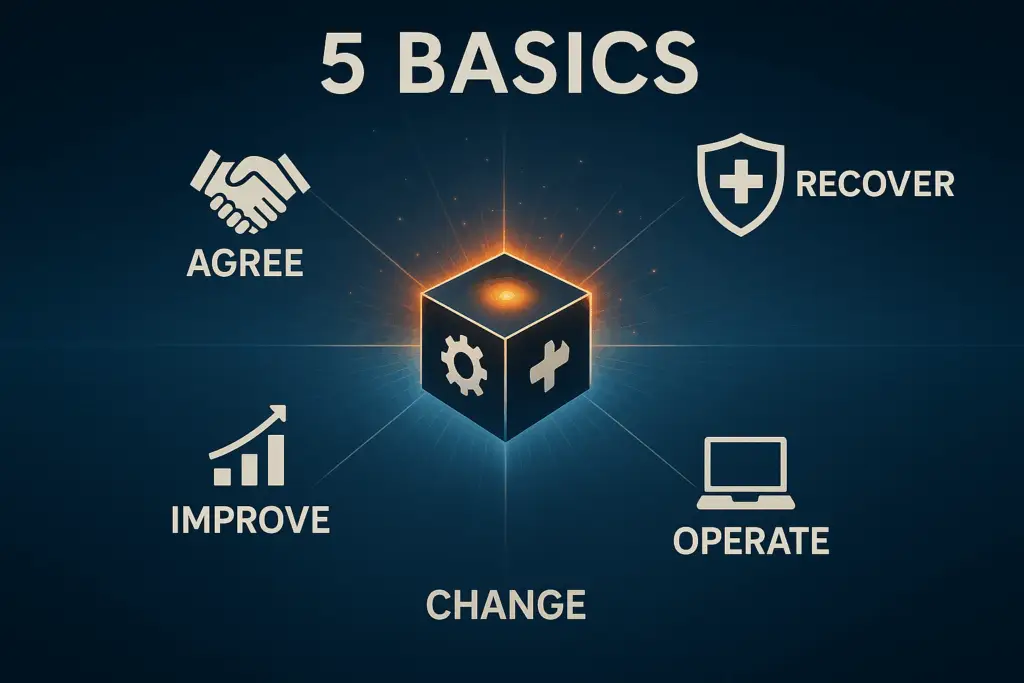
At the heart of USM are five universal processes:
- Agree – Manage service agreements and expectations
- Change – Implement controlled changes to services or infrastructure
- Recover – Restore agreed services in case of failure
- Operate – Deliver and maintain services as planned
- Improve – Optimize services through feedback and innovation
These processes are used to build just eight standardized workflows, which cover all service interactions—both reactive (e.g., incidents, requests) and proactive (e.g., improvements, optimizations).
How USM Is Different
- Principle-Based: Instead of following what others have done, USM starts from first principles to create a tailored, scalable system.
- Tool-Agnostic: USM works with any ITSM, FMIS, or business system—no vendor lock-in.
- Universally Applicable: Whether you’re running IT, HR, finance, or facility services, the same USM structure applies.
- Fast to Deploy: The simplicity of USM allows for rapid implementation and measurable improvements, often at half the cost of traditional frameworks.
Who Uses USM?
USM is used by organizations of all sizes and industries, from hospitals and universities to municipalities and financial institutions. It supports:
- Internal service optimization
- Auditable, compliant operations (ISO 27001, ISO 20000, etc.)
- Cross-functional shared services
- Digital transformation strategies
Conclusion
USM is not another framework—it’s a foundational method for designing and operating a sustainable service organization. It brings order, simplicity, and control to any service environment, enabling teams to focus on what truly matters: delivering value to the customer.
Want to learn more?
Explore our [Knowledge Base], download the [Introduction to USM eBook], or reach out for a guided walkthrough of how USM could work for your team.