
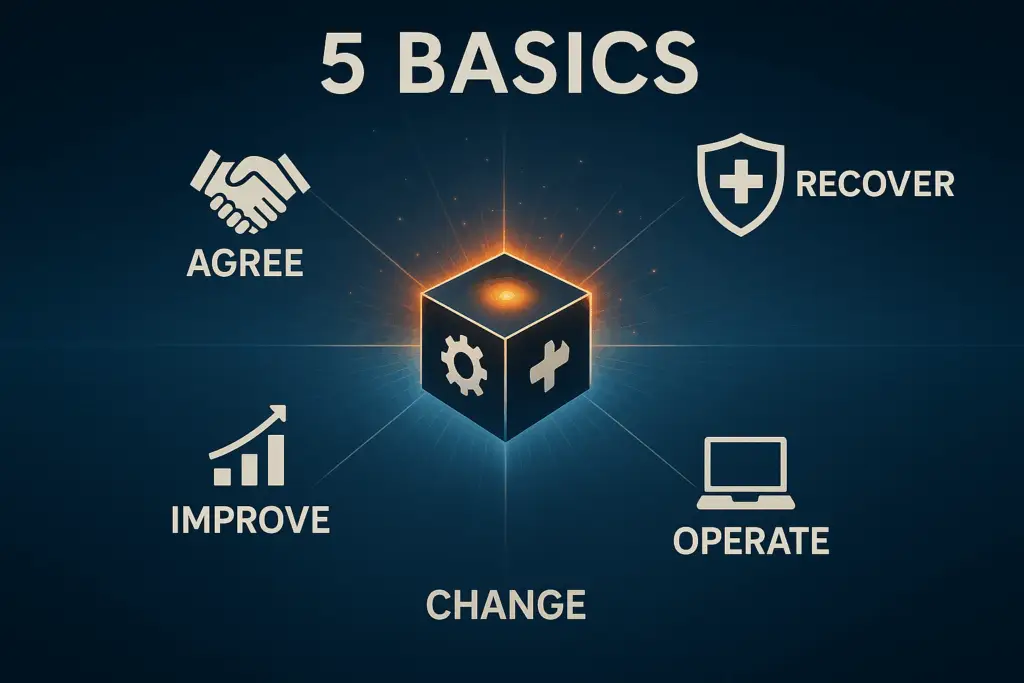
The five basics of USM (Unified Service Management) are its five core processes, which serve as the foundation of the entire USM method. These are:
Agree (Contract Management – CTM)
This process manages the creation and maintenance of agreements with customers, suppliers, and internal teams. It ensures all parties are aligned on the services to be delivered.Change (Change Management – CHM)
Focuses on controlled changes to the service infrastructure. It supports both proactive improvements and necessary adaptations resulting from incidents or new agreements.Recover (Incident Management – INC)
Deals with restoring service in line with the agreed parameters when failures or issues occur. It’s not just about quick fixes but maintaining service levels as agreed.Operate (Operations Management – OPS)
Involves the structured, planned execution of regular service tasks, ensuring continuous and efficient operation of the service infrastructure.Improve (Improvement Management – IMP)
A proactive process that drives ongoing enhancements, learning, and adaptation in service delivery, whether prompted by internal analysis or external input.
These five processes underpin all eight USM workflows, allowing for a universal, standardized, and non-redundant approach to managing services across any domain or industry.
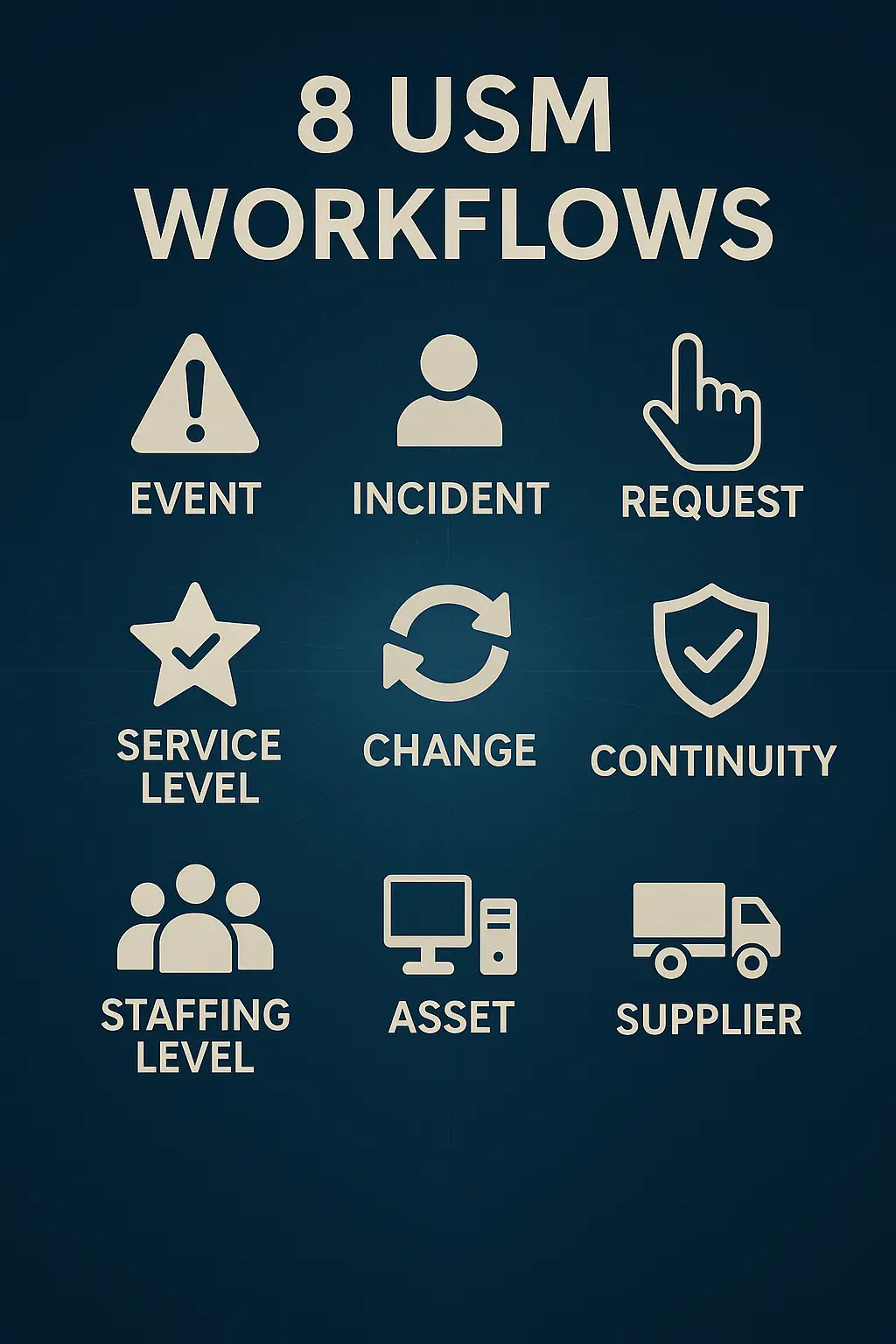
USM uses a minimal set of five standardized processes to manage all service management activities. From these, it constructs eight logical workflows each representing a reusable, non-redundant, and universally applicable pattern for handling typical service delivery scenarios. These workflows are divided into:
5 Reactive Workflows
Triggered externally by a customer, these handle ongoing service delivery:
Wish Workflow
(Agree Process).Triggered by a customer expressing a new need or complaint (called a “wish”).Leads to the creation or modification of a service agreement.Ends in a Change, to reflect the new agreement in the infrastructure.
Request for Change Workflow (RFC) (Change Process)
Triggered when a customer requests a change to an existing service.Starts with planning, follows controlled modification, and ends in deployment.Ends in Operate, executing the modified service component.
Incident Workflow (Recover Process)
Activated by a failure or malfunction.The goal is to restore the agreed service, not just as fast as possible, but as agreed.May involve Change or Operate, depending on whether a structural fix is needed.
Service Request Workflow (Operate Process)
Used for routine service tasks (e.g., providing access, resetting a password).These are pre-agreed operational tasks and don’t change service terms or structure.
Complaint Workflow
Technically a Wish, but specifically addresses dissatisfaction with service performance.Often results in evaluation and adjustment of agreements or operations.
3 Proactive Workflows
Initiated internally by the service provider, aimed at continuous improvement:
Improvement Workflow (Improve Process)
Triggered by performance monitoring, audits, or innovation ideas.Leads to a better structure, process, or tooling.May end in Change, Operate, or even Agree, depending on impact.
Preventive Action Workflow
Based on risk analysis or trend data.Aimed at preventing incidents or performance drops.Often leads to a Change in tools, methods, or agreements.
Optimization Workflow
Focuses on increasing efficiency, value, or cost-effectiveness.May touch all layers people, process, and technology.Ends in improved routines, automation, or simplified structures.
USM (Unified Service Management) enables organizations to streamline service operations, reduce complexity, and enhance performance through a standardized management system. It offers a universal approach to managing services across all domains IT, Facilities, HR, and more.
What USM Delivers
USM replaces fragmented, ad-hoc practices with a consistent, structured framework based on:
-
5 Core Processes: Agree, Change, Recover, Operate, Improve
-
8 Standard Workflows that cover all service scenarios
-
A principle-based architecture applicable to any team or toolset
Business Impact of USM
| Area | Impact |
|---|---|
| Operational Control | Clear structure reduces errors, overlap, and miscommunication |
| Efficiency Gains | Standardized processes speed up execution and decision-making |
| Cost Reduction | Less redundancy, better resource allocation, and smarter tooling use |
| Service Quality | Predictable delivery aligned with customer expectations |
| Employee Enablement | Staff work more effectively with clear responsibilities and routines |
| Customer Satisfaction | Consistent agreements and rapid response to service issues |
| Continuous Improvement | Built-in mechanisms to identify, plan, and implement enhancements |
Strategic Value
USM gives leadership visibility and control over service management operations while enabling front-line teams to act with autonomy and clarity. It provides a scalable foundation for:
-
Enterprise Service Management (ESM)
-
Shared Service Centers
-
Compliance and audit readiness (e.g., ISO, NEN, COBIT)
Summary
USM improves business performance by enabling control, consistency, and continuous improvement in all service operations. It provides a single, scalable management model that aligns people, processes, and technology no matter the domain or toolset.

Want to get in touch
We help you streamline your services with a simple, structured system that boosts efficiency and makes management easy.
© 2026 All Rights Reserved.